
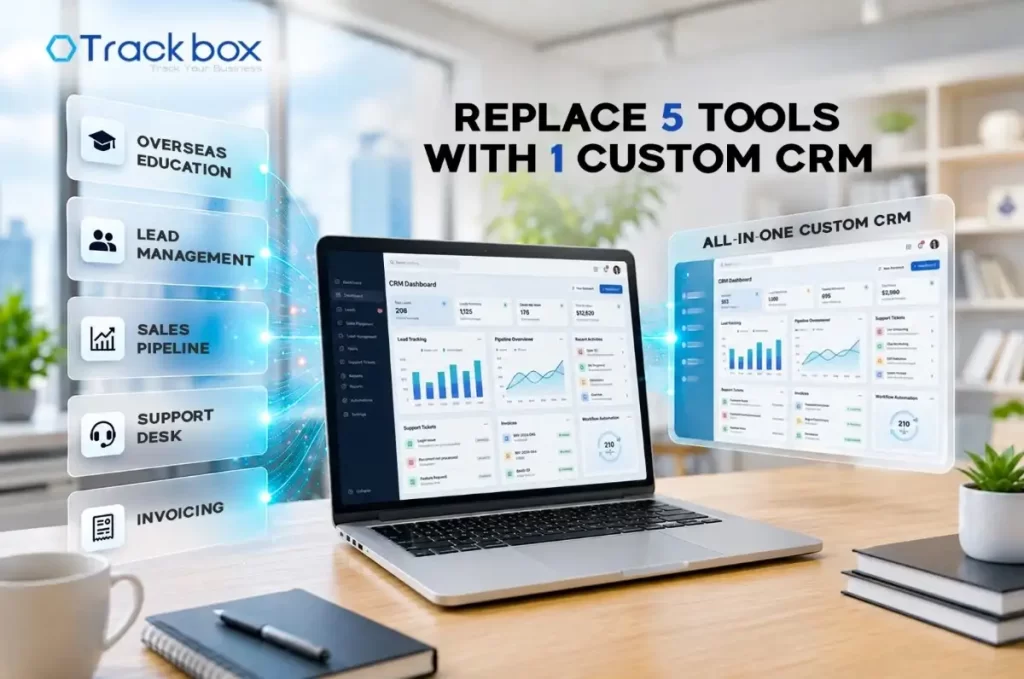
Running a business today often feels like managing software instead of managing customers.
One team uses spreadsheets for leads. Another relies on WhatsApp for customer communication. Sales works from a separate CRM. Operations use a project management tool. Management tracks reports through another platform.
At first, adding new software seems like progress.
Over time, however, businesses discover a different reality.
Information gets scattered.
Teams work in silos.
Manual data entry increases.
Reports become unreliable.
Costs continue to rise.
The result is complexity.
This is why many growing organizations are choosing to replace multiple software tools with CRM platforms that are built specifically around their workflows.
Instead of paying for five disconnected systems, businesses are adopting a centralized business management system that brings everything together under one roof. Businesses looking for long-term operational efficiency often partner with a Leading CRM Development Company in Kochi, Kerala to build systems that match their workflows rather than adapting to generic software.
Let’s explore why this shift is happening and how a custom CRM software development approach is helping businesses simplify operations, improve productivity, and scale more efficiently.
Most businesses don’t intentionally create a fragmented technology stack.
It happens gradually.
A company starts with spreadsheets.
Then adds email marketing software.
Then purchases a CRM.
Then adopts project management software.
Then introduces automation tools.
Then subscribes to reporting platforms.
Before long, employees are switching between multiple tabs all day just to complete simple tasks.
Many organizations are surprised to discover that software fragmentation is costing more than the actual software licenses.
Lost productivity often becomes the bigger expense.
Business leaders are increasingly asking:
“Do we really need five different tools to run one business?”
In many cases, the answer is no.
A well-designed all-in-one CRM platform can manage customer relationships, sales processes, operations, task assignments, reporting, and automation from a single environment.
Instead of forcing teams to adapt to generic software, businesses are investing in tailored CRM solutions for businesses that match how they actually work.
The goal isn’t simply software consolidation.
The goal is operational clarity.
Many businesses still use spreadsheets to track enquiries.
While spreadsheets work initially, they become difficult to manage as lead volume grows.
Common problems include:
A lead management CRM system eliminates these challenges.
With a CRM for lead tracking and follow-up, every enquiry is automatically captured, assigned, tracked, and monitored throughout the customer journey.
No more searching through spreadsheets to find opportunities.
“Can a CRM replace spreadsheets completely?”
For most businesses, yes.
A modern customer relationship management platform offers lead tracking, customer history, task management, reporting, and automation capabilities that spreadsheets simply cannot provide at scale.
Many companies use standalone tools to manage daily tasks.
The issue?
Tasks often become disconnected from customers.
Sales teams don’t see operational updates.
Operations teams don’t know customer status.
Managers lack complete visibility.
A CRM with automated task management solves this problem by connecting tasks directly to customers, projects, enquiries, or sales opportunities.
Everyone works from the same information source.
This improves accountability and execution speed.
Want Fewer Tools and Better Visibility?
Businesses often discover they don’t need more software, they just need software that works together.
Discover where disconnected systems are slowing growth and how a unified platform can streamline your operations.
Sales teams need more than contact databases.
They need visibility.
Without proper tracking, businesses struggle to answer critical questions:
A dedicated sales pipeline management software capability inside a CRM provides these answers instantly.
Managers gain real-time visibility into:
This creates a stronger foundation for growth.
“How does CRM improve sales performance?”
CRM systems improve sales performance by providing structured lead tracking, automated follow-ups, activity monitoring, pipeline visibility, and performance analytics.
The result is fewer missed opportunities and better conversion rates.
Businesses often purchase separate automation software to reduce repetitive work.
But automation becomes more powerful when it’s connected directly to business processes.
This is where workflow automation CRM solutions provide significant advantages.
Imagine:
A powerful business process automation software solution eliminates repetitive administrative work and allows teams to focus on higher-value activities.
Automation should support people, not replace them.
The best CRM systems achieve exactly that.
One of the biggest frustrations for business owners is inconsistent reporting.
When data lives in different platforms, reporting becomes unreliable.
Different departments often produce different numbers.
This creates confusion and slows decision-making.
An integrated CRM platform centralizes business data into a single source of truth.
Management gains access to:
When everyone works from the same data, decisions become faster and more accurate.
Many off-the-shelf CRM systems force businesses to adapt their processes.
Custom CRM software development takes the opposite approach.
The platform is built around the business.
This allows organizations to:
Every business operates differently.
A school, healthcare provider, manufacturing company, construction firm, and service organization have completely different operational requirements.
That’s why enterprise CRM development solutions often outperform generic software.
Customization creates relevance.
Relevance drives adoption.
Adoption drives results.
Before investing in software consolidation, consider whether the platform can support:
The best CRM for business growth and scalability should grow alongside your organization rather than requiring another software purchase every year.
Technology should reduce complexity, not create it.
Yet many businesses unknowingly build systems that make work harder.
When customer information, sales data, tasks, operations, and reporting live across multiple tools, growth becomes difficult to manage.
A unified business software solution creates alignment.
Teams collaborate more effectively.
Managers gain visibility.
Customers receive better service.
Processes become predictable.
Growth becomes scalable.
That is why more organizations are moving toward customer management automation platforms that bring every critical function together in one place.
Is replacing multiple software tools with one CRM cost-effective?
In many cases, yes. Businesses often reduce software subscription costs, improve productivity, eliminate duplicate work, and gain better visibility across departments.
Can a CRM manage both sales and operations?
Modern CRM platforms can support sales and operations automation by combining lead management, task management, workflows, reporting, and operational tracking within one system.
Is a custom CRM better than an off-the-shelf CRM?
It depends on business complexity. Organizations with unique workflows often benefit from custom business management software because it aligns with existing processes rather than forcing teams to adapt.
How long does CRM implementation typically take?
Implementation timelines vary depending on business requirements, integrations, automation needs, and customization levels.
What software can a CRM replace?
A custom CRM can replace spreadsheets, lead management tools, task management software, reporting systems, workflow automation platforms, and other disconnected business applications by centralizing operations within one platform.
The question is no longer whether businesses need technology.
The real question is whether businesses need more software or better-connected software.
Organizations that continue adding disconnected tools often face rising costs, reduced visibility, and operational inefficiencies.
Businesses that consolidate systems into a single, integrated environment gain a significant advantage: clarity.
When leads, customers, operations, tasks, automation, and reporting work together, teams perform better and growth becomes easier to manage.
For businesses looking to simplify operations, improve customer management, and build a scalable foundation for future growth, TrackBox delivers tailored CRM solutions designed around real business workflows.
As a Leading CRM Development Company in Kochi, Kerala, TrackBox helps businesses replace fragmented software ecosystems with a unified CRM platform built for growth.
Ready to Replace Multiple Tools With One Powerful CRM?
Discover how a custom-built CRM platform can streamline your sales, operations, customer management, and automation workflows.